 en
en
 Français

Les Plus Beaux Villages de France by train and on foot
Les Plus Beaux Villages de France, accessible by train and on foot
Setting off from the main regional or departmental railway stations, travel to some of our Les Plus Beaux Villages de France by train, then walk the final few kilometres (or metres!)! Distance, elevation gain, route… We’ll guide you every step of the way!
N.B.: There’s nothing to stop you setting off from another town and travelling to the stations mentioned in our suggestions. To do this, use the SNCF Connect to plan your journey.
From Lyon, take the train to visit Pérouges (Ain)

Méximieux–Pérouges Station

20 mins
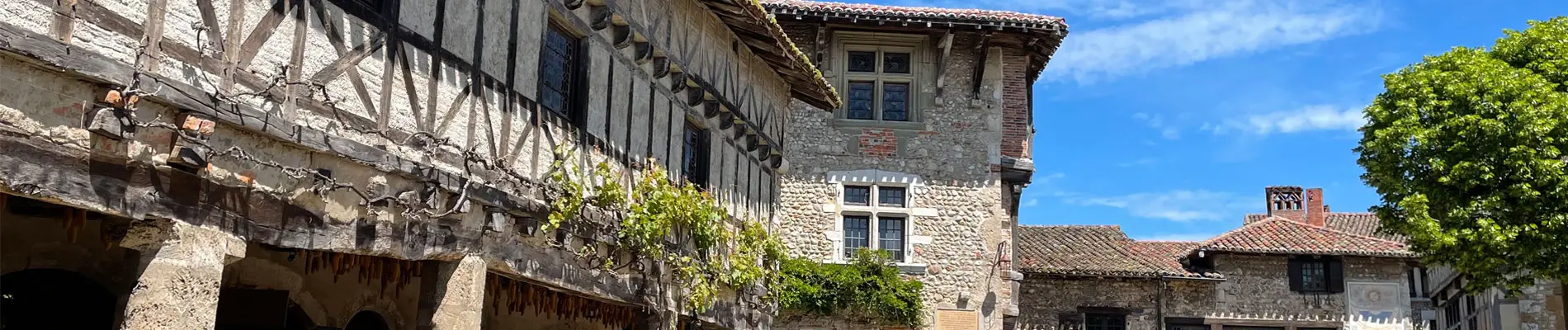
It’ll take you no more than 30 minutes by train from Lyon-Pardieu to step back in time to the Middle Ages and visitPérouges! Overlooking the Ain plain, this former weaving and wine-growing town – saved from ruin in the 20th century – is a 20-minute walk (with a 65-metre climb) from Meximieux–Pérouges station.
> Turn left onto Avenue de Verdun as you leave the station, then continue along Rue Marcel Vion until you reach the roundabout. Take the narrow street directly opposite you (Rue du Moulin). At the next junction, continue along Rue de l’Egalité, keeping slightly to the left, until you reach the D4 road. Turn right and follow the D4 for a few minutes until you see the sign indicating the footpath leading to the town, on the right.
Not to be missed:
- A tour of the village: the streets paved with uneven pebbles from the bed of the River Dombes, the Place du Tilleul lined with medieval half-timbered houses, the fortified church, the old Renaissance-era weavers’ houses with their corbelled façades and mullioned windows, the Musée du Vieux Pérouges…
- The craft workshops and the Maison des Arts Contemporains: to discover all the town’s creative talents (potters, painters, bookbinders, stained-glass artists, sculptors…)
- The Galette de Pérouges: a reimagined sugar tart whose aroma wafting through the village streets is sure to tempt you!
From Brive-la-Gaillarde, take the train to visit Capdenac-le-Haut (Lot)
Capdenac railway station
40 mins
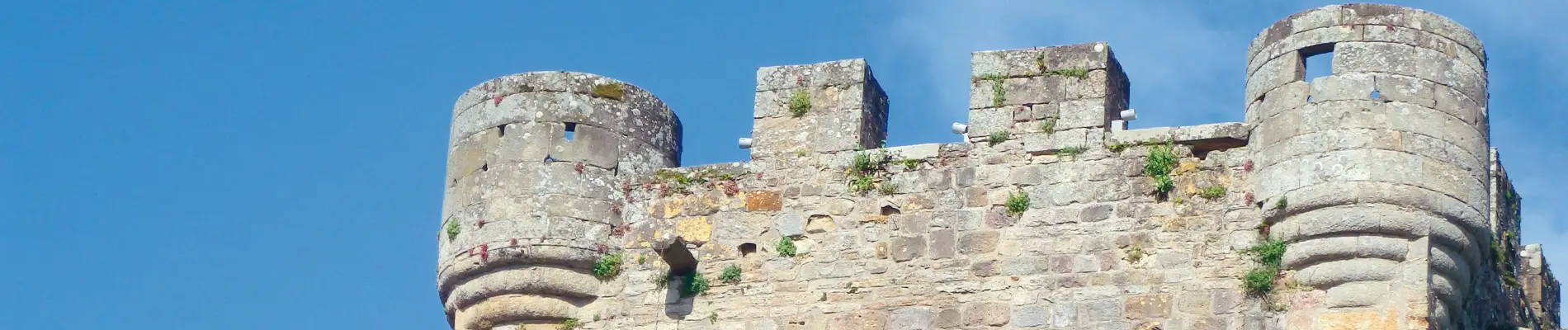
Off to Quercy, following in the footsteps of Julius Caesar, to the aptly named village of Capdenac-le-Haut ! It was indeed on a rock overlooking a bend in the River Lot from a height of over 110 metres that this important oppidum was established, the site of the last Gallic battle led by the Roman emperor. Book your train from Brive to Capdenac-gare, at the foot of the village, for a journey of 1 hour 30 minutes.
> It will then take you around 40 minutes to walk up to Capdenac-le-Haut via Les Peyrières. The 130-metre climb will be a distant memory once you’re settled at a table in the village restaurant or in the shade of the trees on Place Lucter.
Not to be missed:
- A tour of the village: the fortified gates of the citadel, the ‘Fontaine des Anglais’ (the Englishmen’s cave fountain), the keep (housing a museum of history and prehistory), the 18th-century mansions…
- The Medieval Garden of the Five Senses: a beautiful collection of medicinal plants and vegetation organised by theme (hearing, touch, smell, sight, taste).
- The Garden of 1,001 Legs: an ecological garden featuring a gigantic insect hotel.
Bonus: From Capdenac-Gare, you can also visit two other villages listed amongst Les Plus Beaux Villages de France: Najac, whose station is a 25-minute walk from the village, and Cordes-sur-Ciel, whose station, Cordes–Vindrac, is less than 5 km away.
Book your ticket with SNCF-ConnectFrom Agen, take the train to visit Belvès (Dordogne)
Belvès railway station
15 mins
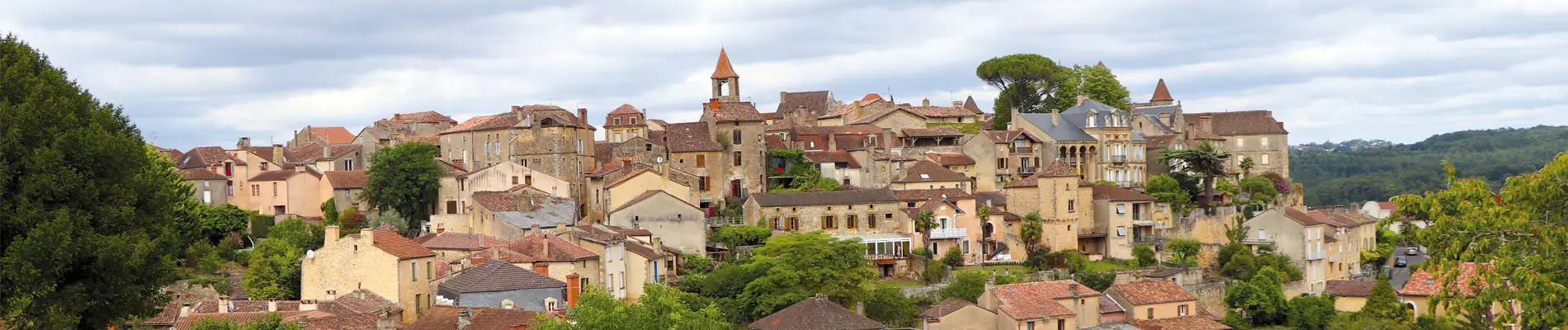
A getaway to the Périgord in Belvès, a medieval and Renaissance town in the lush Nauze Valley! The village still has a working railway station, just a fifteen-minute walk from the charming Place de la Halle. From Agen station, the train journey takes 1 hour 20 minutes.
> As you leave Belvès station, turn right and follow the railway line until you see the Côte de l’Oratoire on your right. Cross the D52 and then turn right onto Rue Foncastel. This will take you straight to the market hall.
Not to be missed:
- A tour of the village: either via an audio guide (free downloadable tour) or a fun family-friendly version (educational booklet for children) to explore the village ‘with its seven bell towers’, the Renaissance paintings in the Church of Notre-Dame-de-l’Assomption, the old castle and its murals – unique in Aquitaine…
- The cave dwellings: Beneath the market hall, 5 or 6 metres underground, discover the daily life of the peasants in these ancient cave dwellings, which were inhabited from the 13th to the 18th century.
- The Belvès spinning mill: Just outside the village, this former medieval mill, converted into an industrial spinning mill in the 20th century, offers themed displays, exhibitions, demonstrations, introductory workshops and a shop selling original designs.
From Perpignan, visit Villefranche-de-Conflent and Eus (Pyrénées-Orientales)
Villefranche – Vernet-les-Bains railway station
15 mins
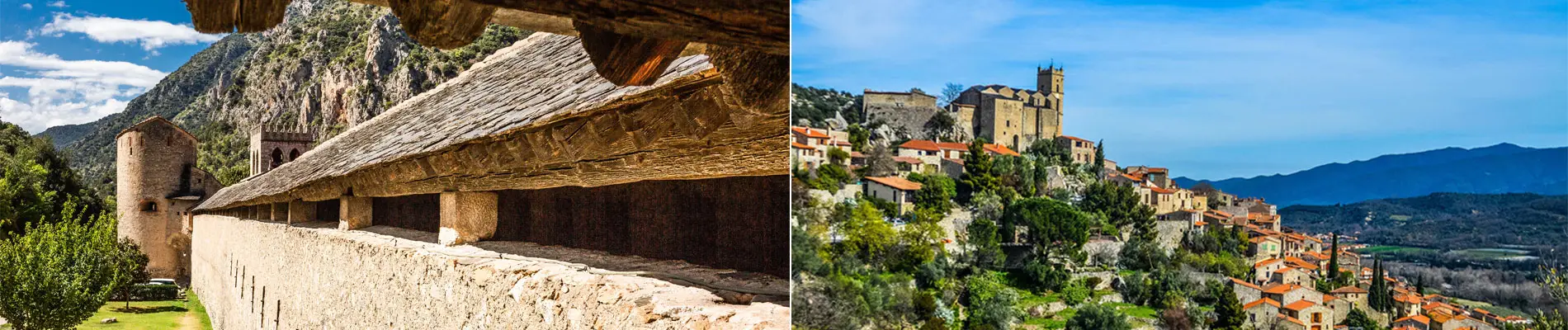
Welcome to Catalonia! From Perpignan, between 11.00 and 19.00, there are numerous trains to Villefranche – Vernet-les-Bains station, situated less than a kilometre from Villefranche-de-Conflent (a 15-minute walk).
> From the station, you can head straight onto the path leading up to Fort Libéria, a walk of less than half an hour with a 165-metre climb. Finally, once at Villefranche-Vernet station, don’t miss out on a highlight of Catalan heritage: the ‘yellow train’! It will take you into the Cerdagne region in the Pyrénées-Orientales, as far as Font-Romeu or Latour-de-Carol. An unmissable way to explore the area at a different pace.
Bonus: On the same Perpignan–Villefranche line, stop off at Prades–Molitg-les-Bains station to visit Eus , also listed among Les Plus Beaux Villages de France. As the station is 6 km from the village, we recommend cycling there! A short half-hour cycle through the town and then the orchards of Eus – with a few steep climbs – and you’ll be able to relax on the terrace of the local bar-restaurant and admire the scenery
Not to be missed:
- A visit to Villefranche-de-Conflent: the ramparts encircling the town of this former military capital, the Church of Saint-Jacques, with its Romanesque portal and Baroque furnishings, and the streets lined with tall houses featuring pink sandstone façades and bustling with shops…
- Fort Libéria: Perched on the mountainside, overlooking the village, this ingenious network of galleries protected by gun emplacements forms part of the fortification system developed by Vauban and is a UNESCO World Heritage Site. It is linked to the village by the ‘thousand-step’ staircase.
- A visit to Eus: for a stroll through the cobbled streets of this hilltop village with its old schist houses, offering, at the summit, a breathtaking view of Mount Canigou… and in summer, for its cultural events centred on contemporary art and music.
From Toulouse, take the train to visit Najac (Aveyron)
Najac railway station
25 mins
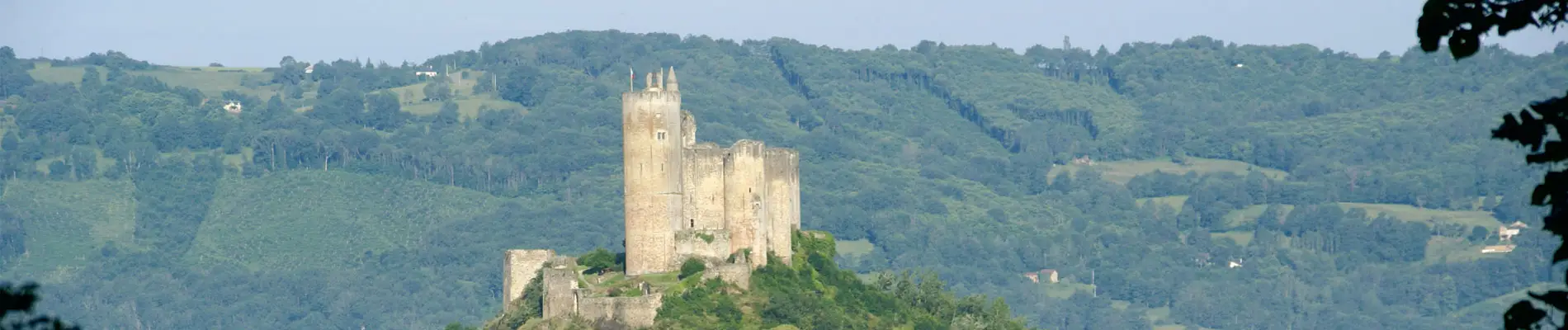
About twenty kilometres south of Villefranche-de-Rouergue, treat yourself to a bird’s-eye view of the Aveyron Gorges from the fortress of Najac ! The village’s railway station is very well connected to Toulouse-Matabiau station.
> In under an hour and a half, escape to the countryside in this bastide town, where the castle – the highlight of the visit – is a 25-minute walk from the station along a path through the woods. But be warned: you’ll need a bit of stamina to tackle the climb of nearly 150 metres! If you need to, pop into the outdoor activities centre and hire a mountain bike!
Bonus: From Toulouse, you can also travel to Capdenac station to explore Capdenac-le-Haut (Lot) (see above).
Not to be missed:
- A tour of the village: along the rocky ridge leading up to the castle, stop at Place du Barry to admire the stone or half-timbered houses topped with magnificent slate roofs, then visit the 13th-century Governor’s House, which houses the Rouergue Bastides Architecture and Heritage Interpretation Centre. In summer, opt for the guided torchlight tour and, if you’re with the family, follow in the footsteps of the “Master of Najac’s Secrets”…
- The royal fortress: dating from the 12th–13th centuries, it has retained its keep, Saint-Julien Chapel and the governor’s chamber.
- The ‘fouace de Najac’: this orange-blossom brioche, which you can find in the village bakery, even has its own festival at the end of August. A little treat to reward you for your walking efforts!
Book your next trip with SNCF-Connect
Train holiday ideas – Discover our other suggestions in ‘Les Plus Beaux Villages de France’:
- Les Plus Beaux Villages de France accessible by train and bike
- Les Plus Beaux Villages de France by tourist train
